

The Quiet Return of Bootstrapping
After a decade of venture capital being the default, more founders are choosing not to raise. The math, and the lifestyle, both deserve attention.
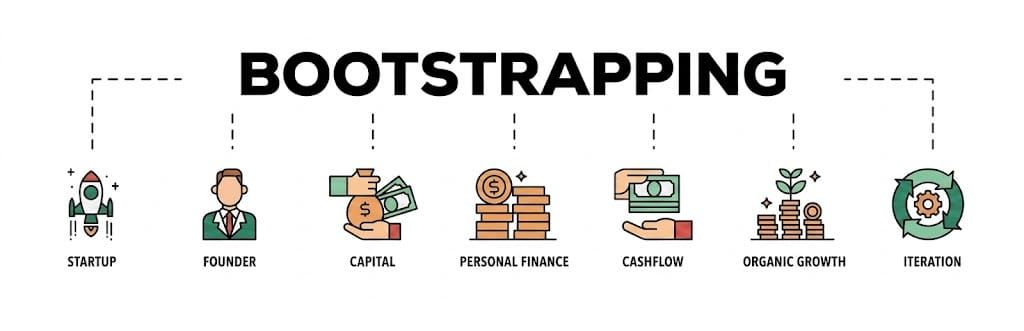
For about a decade — roughly 2012 to 2022 — venture capital was the default path for ambitious founders, and bootstrapping was the path for people who either couldn't raise or didn't have ambitions large enough to justify raising. This framing was wrong even at the time, and it's collapsing now. The bootstrapped path is producing some of the most interesting outcomes in business, and a meaningful number of founders are choosing it deliberately rather than as a fallback.
The financial logic alone is worth examining. A bootstrapped company that reaches $5M in annual revenue with healthy margins might generate $1M in annual profit for the founder, who owns 100% of the company. A venture-backed company at the same revenue, with the same product, might be unprofitable (because of growth investment) and the founder might own 30-50% after multiple rounds of dilution. The first founder's annual income is higher, the second founder's potential exit is higher, and the right answer depends entirely on what each founder is optimizing for.
A few patterns are visible in the wave of bootstrapped companies emerging right now.
Software companies are increasingly bootstrappable in ways they weren't a decade ago. The cost structure of running a software business has dropped dramatically — cloud infrastructure is cheaper, no-code tools have reduced engineering needs, AI is replacing certain functions, and the standard playbook of distribution has matured. A software company that would have required $5M in venture capital to get to $1M in revenue ten years ago can sometimes get there now with $50K and disciplined operating.
The companies that are taking advantage of this shift tend to be in specific categories: vertical SaaS, productivity tools, niche B2B software, infrastructure tooling. The category economics are smaller than the consumer software businesses that drove the venture wave, but the unit economics are often dramatically better.
The information ecosystem for bootstrapped operators has matured. A decade ago, if you wanted to learn how to run a bootstrapped company, the resources were thin — a handful of blogs, some scattered books, a few podcasts. Now there's a substantial ecosystem: the IndieHackers community, podcasts like Bootstrapped Founder and Indie Hackers, books from operators like Sahil Lavingia (The Minimalist Entrepreneur), and a real public conversation about the trade-offs.
This matters because it means bootstrapped founders can learn from peers in ways they couldn't before. The information advantage that used to belong to venture-backed founders (who had partners, networks, and structured advice) has been substantially equalized.
The lifestyle case is genuinely strong. This is the part that gets least covered in business media because it's not photogenic, but it matters enormously to the founders making the choice. A bootstrapped founder running a $3-5M business is typically working 35-50 hours a week, has full control over the business, doesn't have to pitch to anyone, doesn't have a board, and is making more money personally than most VC-backed founders at similar revenue levels.
The lifestyle isn't lesser; it's different. Some founders genuinely thrive on the venture path — the scale, the team-building, the public profile, the optionality of large outcomes. Others find that the same path produces stress, distraction, and a job they don't actually want. The healthier framing is that bootstrapping and venture-funding are different jobs, not different levels of ambition.
Several specific categories favor bootstrapping right now. Consumer brands with genuine product differentiation and strong direct-to-consumer economics. B2B software in vertical niches where the addressable market is moderate but the willingness to pay is high. Marketplaces in categories that don't require enormous scale to be valuable. Service-based businesses that productize parts of their delivery. Newsletters, content businesses, and creator-led companies.
The common thread across these is that they don't require massive capital to reach meaningful scale, and the operational complexity stays manageable for a small team. The categories that don't favor bootstrapping are mostly capital-intensive ones (deep tech, biotech, hardware, marketplaces with strong network effects requiring fast scaling) and ones with clear winner-take-most dynamics where being second is fatal.
The underrated risk of bootstrapping isn't financial; it's psychological. Bootstrapped founders, especially solo bootstrapped founders, can experience extreme isolation. There's no co-founder, no investors who care about how you're doing, no team that depends on you, no external pressure to keep going. The financial risk is lower than venture-backed founders face, but the psychological risk of grinding alone for years is real.
The bootstrapped founders who do well long-term are usually the ones who solve for this explicitly. They join peer communities. They invest in friendships. They take real time off. They build collaborative relationships even when they don't have employees. They treat the isolation as a real risk and design against it.
The math of bootstrapping is often misunderstood. The standard objection to bootstrapping is "you can't get rich bootstrapping the way you can with venture capital." This is true in extreme cases (no bootstrapped consumer SaaS founder is going to match Mark Zuckerberg's net worth) but it's wrong in the ordinary case.
A founder who builds a $10M-revenue bootstrapped business with 30% margins and runs it for ten years has generated $30M in personal earnings, owned 100% of the equity, and has a business that's worth at least 2-4x annual revenue if they want to exit. The total economic outcome can easily be $50-100M+. This is competitive with the median outcome from venture-backed companies, and dramatically less risky.
The exits that do happen for bootstrapped companies are sometimes substantial. Mailchimp sold to Intuit for $12B, fully bootstrapped. Wistia, Basecamp, ConvertKit, Litmus, and many others built durable businesses that have been worth substantial sums. The misconception that bootstrapping caps your upside is partly true (you probably won't build a $50B company without venture capital) and mostly false (you can absolutely build a $50-500M company without it, and many founders are doing exactly that).
The decision frame. For founders who haven't made up their minds: the right question isn't "should I raise?" — it's "what kind of company am I trying to build, and which path serves that vision?"
If you're building something that genuinely requires capital to win — a market with strong network effects, a category where being first to scale is essential, a business model that requires substantial upfront investment — then venture capital is the right path. If you're building something with strong unit economics, a clear path to profitability, and a market that doesn't require explosive growth to be valuable, bootstrapping is often the better path.
The default of the last decade was wrong. Venture capital was right for some businesses and wrong for many. The current generation of founders is correcting that default, and the result is a healthier, more diverse ecosystem of company-building paths. The right path for any individual founder is the one that matches the business they actually want to build, not the one that matches the cultural narrative of what success is supposed to look like.